Showing posts with label patients. Show all posts

Sunday, June 10, 2012

The Royal Morgue

People often ask me how is it to work with the members of the Saudi royal family, what are the Princes and Princesses like? To put it short, they are just like any of us, but with some financial and social benefits :)
I wanted to share this interesting incident that once happened to me at work.
The Saudi royal family is huge, estimated to consist of around 15,000-20,000 members. The royals have their own specific services in some of the Saudi hospitals, read more about them here: http://blueabaya.blogspot.com/2010/10/saudi-arabia-and-vip-patients.html

Although they're not designated to accommodate the Saudi royal family, there are the occasional royal patients admitted on the regular wards. Many of them actually request to be assigned a bed on these wards to be under the specific medical service rather than the VIP service, thus getting care more specific to their condition, not status. That and some want to avoid the VIP ward like the plague because of rumors within the extensive royal family. A patient will have many visitors and the other royals will recognize which family it is and there will be talk.

So the incident happened when I was relatively new to the Kingdom and not fully familiar with all the VIP protocols and hassles. It was a regular night shift until the charge nurse received a phone call for an admission from the ICU. I heard her screaming on the phone informing them we didn't have empty beds, then shaking her head in disbelief and putting the phone down. The other Asian nurses gathered at the nursing station starting to speak loudly in Malay and Tagalog. Since I had noticed this was common occurrence I thought nothing of it.

After a while the admission was to arrive and I saw some nurses getting a room ready. They had transferred one patient onto another ward to empty the room. I was busy with my own patients and because I was not the nurse allocated to receive the new patient, continued to ignore the racket the Asian nurses were causing over the transfer. I was the only western nurse on duty and they usually didn't bother to tell me what was going on so I thought it was insignificant.

When the patient finally arrived from the ICU on her bed suddenly all the other nurses, including the charge and the allocated nurse suddenly disappeared like samboosas on Ramadan. I saw the western ICU nurse pushing the bed with some five male relatives. The patient was totally covered with a white sheet, which is normal in Saudi for the female patients. When they get transferred on their beds around the hospital, for privacy reasons they pull the white sheets on top of the whole patient resulting in a going to the morgue-look.

So as the only nurse around I received them with a friendly greeting and directed them to the room. Next we had to transfer the patient to the ward bed. We turned the patient and placed the sliding board underneath pulling her to the other bed. I thought it was odd they still hadn't wanted to remove the covers, but had gotten accustomed to seeing all sorts of things and again thought nothing of it. I took notice of the pristine white crisp thobes and strong perfumes the men were wearing and assumed they were of upper class status.

Next the male relatives started to fuss about the A/C. The most common immediate complaint the patients have when they come to the rooms is the air conditioning is too COLD. Saudis are afraid the cold air will worsen all illnesses. So I assured them I would adjust it to make it at hot as possible. The looks on their faces were as if I'd said something to the likes of " I will give the patient heroine".

The oldest one replied now clearly upset in English, "no we want cold! And bring ice! We need lots of ice." I informed them of the ice machine we had in the patient kitchen which they could use freely. The men looked at each other and I got a feeling they weren't liking my services so I excused myself and left the room.

I had the patients file now in my hands but did not have time to look at her details, rather I wanted to find the allocated nurse to hand over the file to but she was nowhere to be found. Next a myriad of black clad women started entering the ward. They were all dressed in designer abayas, wearing high heels and had covered their whole heads with the ends of their shaylas (scarves) thrown over the faces. The smell of expensive bohkoor and perfumes filled the ward. I felt a sense of curiosity now and checked the patient name. Al-Saud. And the two names before that made me gulp.

Now it started to make sense why all the Asian nurses had vanished and were still hiding in the patient rooms. I was still the sole nurse visible on the ward, standing like a statue now at the nursing station not knowing what to do. The female relatives asked for the room number and inquired what would happen. Some were weeping frantically and waving their hands in the air chanting something I assumed were prayers. Others were being walked by two Ethiopian maids on each side. One needed a wheelchair. I had seen all the drama Saudi women could create but nothing to this scale before.

Finally the frightened charge nurse emerged from her hiding place. I asked her what was going on and the whole insane truth was revealed. The patient was indeed a royal Princess. As a matter of fact, she was also deceased. They had just admitted a dead body. I had unknowingly been transferring a deceased royal Princess. I gasped at the thought of not only handling a dead body like one that was alive and thought back at everything I had told the relatives. Why didn't the nurses inform me? It seemed I was the last to know again.

Naturally in Saudi like all other hospitals around the world, the deceased patient will be washed and prepared and then transferred to the morgue. According to Islam the body should be buried as soon as possible and any decaying of the body should be avoided. The process in Saudi is very swift compared to what we are used to in the west, where the bodies might be in the morgues weeks at a time for example. Very seldom are autopsies carried out in Saudi-Arabia. Once the patient dies, the families take it as a decree from Allah and the reason of death to them becomes insignificant, unless they suspect a gross violation from medical staff which is extremely rare (that they would suspect or care).

So why was the dead body of a royal Princess occupying one the beds on our ward, not the morgue, or the VIP ward which has huge rooms complete with separate guest rooms? Well the reason is simply that is what the family wanted and because of their status, they could make it happen. They wanted for all the relatives and especially the King to be able to say goodbye to her before she was taken away, and the morgue would not be a place fit for a Princess as high as her. How could the royal relatives visit the morgue anyway?

So ice was brought in by the truckloads, the AC was adjusted, gigantic flower arrangements and golden chairs fit for Princesses to sit on were brought in from the VIP ward and when there was no space left inside the room, the hallway leading to the room was lined with them. Expensive bokhoor was burned in the room (it is forbidden normally) and the "royal morgue" was up and running.
Relatives kept coming in and out causing quite a lot of confusion in the other patients. There was hysterical crying in the hallways, maids coming in with trays of chocolates, pastries and other foods serving Arabic coffee from the intricate golden dallahs, drivers and guards were hanging around the hallways.

One of the younger princesses couldn't handle the stress and Her Highness was brought to me to measure her blood pressure. I took the moaning and groaning princess to sit in a quiet area and took the readings. They were slightly elevated but nothing to worry about, I said. The male relative strongly disagreed and demanded to see a cardiologist at once. He ordered me to give blood pressure medication on the spot.

I tried to explain to him how first of all since the woman was young and not on any medications I could not just go and get a blood pressure medication randomly, and second there are maybe hundreds of medications and doses to choose from and third, I could not even get it out of the machine without a doctors orders and her being listed as a patient on this ward, and fourth no doctor would even prescribe to her any medication based on these readings. I told him it's best we let her sit for a while and drink some water and try to relax, she will be just fine. He was clearly upset at what I had suggested and acted as if the woman was going to have a heart attack.

But as is common with demanding Saudi patients my explanations were not good enough and so I was forced to call the cardiologist who in turn had to come from the cardiac surgery unit down to the floor. He was extremely angry at me for calling him, even if for a royal princess. When he saw the readings which were by now even better, he simply laughed and left. The male relative (could've been her husband, brother, father or grandfather you never know here) was upset at the lack of service and took the faint princess elsewhere. I was relieved.

It was now nearing Fajr prayer time and the worst traffic to the newly established morgue had quieted down. The Asian staff were all mostly hiding in the staff room or patients rooms, trying to avoid any contact with the royal family in fear of saying or doing something to upset anyone and as a consequence, loosing their jobs.

There was still no word when the King would make his appearance to say his farewells. There were guards placed on all the entrances and all of the staff was anxiously awaiting his arrival. I was actually excited to have the opportunity to at least see him.

By the time night shift was over the ward had started to have a distinct deathly smell to it. Especially around the room turned morgue the stench was getting almost unbearable despite all the bokhoor and flowers. To my diappoinment I never got the chance to meet the King.
Eventually the King had arrived for a quick visit that afternoon and only after that was the body taken to the cemetery for burial.

This is one of the stories from the hospital I will never forget. And it could only happen in the Magic Kingdom!


Monday, February 13, 2012

Why Do Saudis Spit On People?

Believe it or not this is an actual question I get asked every once in a while.

Expat nurses often ask me about some strange habits Saudis have and odd stuff they saw patients doing. I guess being married to a Saudi gives me more insight into some things but don't get me wrong, I'm no Saudipedia. But I like to correct some common misconceptions whenever I can.

Often some of the questions I get asked are related to Islam. For example why do Saudi men constantly fiddle with the prayer beads, why do Saudi men chew on sticks or why do Saudi women splash water all over the bathroom floors? Others are more cultural such as why do some female patients keep their whole head covered with a cloth while the doc examines her "down under"? Why do Saudis throw all the trash on the hospital floors or why do Saudis cluck their tongues all the time?

I don't have an answer to everything, although sometimes I wish I understood.

Back to the question about the spitting on people. First of all I like to point out that although it does look and sound like the person is in fact spitting on the patient, he is by no means *spitting*. What is happening is actually praying. The person is reciting Quran and kind of "blowing" the words onto the patient. If anyone knows how to explain this better, feel free to leave a comment.

Muslims believe that reading the Quran on the sick person has healing abilities and this is why nurses will often witness this behavior with patients. I've known many nurses that have been disgusted by the practice because they honestly don't have a clue of why someone would spit on their sick relatives.

Well thankfully some of the confused nurses want to find out what is actually going on while others just like to remain ignorant and poke fun at the Saudis saying, they like to spit on people! I have to admit I've witnessed some pretty "enthusiastic" styles myself and saliva has certainly been seen flying around, especially with Bedouin patients. But this practice is only a sincere attempt to cure the patients :)

For more weird habits of Bedouin patients check this post: http://blueabaya.blogspot.com/2010/06/bedouins-as-patients.html
Read about Saudi women who never remove their veils here: http://blueabaya.blogspot.com/2011/06/eternal-veil.html

Blogger Qusay sent me this clip it shows little kids imitating the reading and blowing, very cute thanks!


Friday, January 20, 2012

The Princess And The Pimple

Believe it or not, based on a true story..

Once upon a time in the Magic Kingdom lived a young Princess called "Abeer". She lived in a huge palace with her parents and had a Pink Hummer driven by her private chauffeur.

One morning Princess Abeer woke up and upon looking in the mirror screamed: "Noooo! Yaaa Allah this can't be happening to me! Tomorrow is Fatima's wedding party!"

A gigantic red pimple stared back at her form the mirror. Worse yet it was in the middle of her forehead. "I look like a freak! Yaa maamaa!" she shouted in panic as she ran downstairs into the palace courtyard to find her mother.

"Mother what shall I do now, look at me I am so ugly! Tomorrow I must look my best because Prince Mishaal's mother will be at the wedding to check me out! He won't propose if I look like a three-eyed monster!"

"Yaa Rabb, poor girl. Don't worry dear Beero, we will go to the hospital and tell them to give you some medicine for the pimple."

So the Princesses left to the emergency room with their maids in tow. In the car Princess Abeer instructed the driver "Yalla ya Munir I am in great pain! Drive faster! Remember to use the royal entrance to the hospital so we don't have to queue!"

On arrival at the ER the poor Princess was so weak she needed a wheelchair. The driver fetched the chair for her and they rushed her into the VIP section of the ER. A nurse and a royal officer immediately attended to the Princess and she was whisked past the overcrowded side of the ER full of  the ordinary patients.

The Princesses had both thrown the black scarves over their heads so that their true identity (and the protruding pimple) would remain hidden. The nurse apologized and told the them to wait because she was busy with a very ill baby in the other room. The Princess got extremely upset.

"Sister don't you know who I am?! I am Princess Abeer bint so and so bin so and so bin so and so bin AbdulAziz Al Saud. You must attend to me first!"
"But your Highness, the baby might die!"
"I don't care! This is an emergency situation! she exclaimed, sister get me the doctor NOW!"

The nurse ran off to fetch the doctor, she knew not to mess with the royal family members after some of her colleagues had been "dismissed" and sent on the next flight home after criticizing the VIP status of some patients. A Saudi male doctor specializing in royal medicine arrived to examine the royal patient and asked her to remove the veil. The Princess whimpered in pain and exhaustion as she lay on the bed and finally removed her scarf.

Her mother with a stern voice advised the doctor: "Doctor we have imboortant event tomorrow and Abeer needs to be a beerfect condition. Blease doctor we need a medicine." "And I'm in pain!" the Princess added.

The doctor looked at the pimple for a moment and then gave his orders to the nurse: "Take her vitals, do blood tests, insert IV line and start her on intravenous Ceftriaxone. Give Pethidine 100 mg I.V. Apply Bacitracin ointment on the pimple Q.I.D.
"Don't worry your Highness we have it under control. The antibiotics will take care of the infection in no time and you will receive a pain killer now."
"Thank you doctor! Now sister, call the kitchen we want to order some food!"

The nurse went off to follow the doctors orders shaking her head in disbelief of such vanity and the unnecessary medical interventions. The VIP kitchen staff arrived at bedside to take their order. "Freshly squeezed orange juice, chicken burgers, fries..oh and cupcakes and kahwa please! Yalla besurah!" the young princess instructed.

The nurse returned to insert the I.V. line and the Princess shuddered. "Please sister I want the cream first!"
"But it's only for children your Highness and it won't hurt really, I will be very quick." "No, mama I want the cream!" "Sister, blease ze cream now." the mother Princess confirmed nodding her head.

The nurse applied the numbing cream to the princesses hand. "Sister blease, put ebra here so tomorrow mafi mushkila at wedding" the mother demanded. "But your Highness, placing the cannula high on her arm on the inner side will cause her great pain and it is not per policy either." "What is zis bolicy sister? Yalla but ebra now sister!" the mother Princess looked annoyed so the nurse forgot about reasoning and proceeded.

Despite the cream she screamed in pain from the injection. "Shweia shweia sister, shweia shweia!" The mother disapprovingly clucked her tongue. The nurse then proceeded to apply the antibiotic cream on the pimple. "Shweia shweia sister!" Cluck cluck cluck.

Finally the antibiotics were hooked and the Princess dozed off from her narcotic painkiller. She and mother princess spend the night in the ER on I.V fluids watching movies from the flat screen TV and calling the nurse to run different errands for her throughout the night. The maids massaged their feet.

In the morning the doctor came to check the patient. "Your highness the infection is improving. We can discharge you but continue your antibiotics at home for a week and keep applying the cream."

The pimple had indeed disappeared over night. "Thank you doctor! Sister, we want leave now so remove ze ebra and give us a medicine, besurah besurah!"
Upon leaving the hospital the mother Princess made a complaint of the nurses rude behavior to the Patient Relations Officer.

The Princesses returned to the castle and all was well in the Magic Kingdom.

And the Princess lived happily ever after, without the pimple.

Read more about how VIP patients get treated in Saudi hospitals:
http://blueabaya.blogspot.com/2010/10/saudi-arabia-and-vip-patients.html

Vocabulary
Ebra= Needle
Besurah=hurry
Mafi mushkila=no problem
Sister=what all Saudi patients call nurses
Shweia=little, carefully
Pethidine=Extremely addictive narcotic painkiller
bint/bin=daughter/son of
Rabb=Lord

Monday, December 5, 2011

Saudi Hospitality

I experienced hands on the generous side of the Saudi people by having the chance to interact with many families through my work. At the hospital a patient would have their own private rooms and the average length of stay would be 8 days. A nurse typically works around 12 hours a day, on average 4-5 days a week. Also the system in Saudi is that a certain nurse is assigned to specific patients only (usually 2-4/shift) and the nurse therefore get lots of one on one time with their designated patients.

At first it was a strange system for me as a western nurse used to having the responsibility of up to 35 patients at a given shift. Then I saw the good side to it, getting to really know your patients and following their progress and treatment. This way their outcome will be better because the nurses can observe the patients closely and report changes to the doctors.

So having this close contact with the Saudi families gave me the chance to experience this amazing side to their culture which is hospitality and kindness to strangers.

I know some nurses who worked in Saudi or even the very same ward would not agree with me and might say Saudis are rude and arrogant. I think this has to do with personality and attitude. My approach is always open-minded and I would greet patients with a smile and "salaam aleikum". Even though I was not a Muslim at first, I thought it was polite and respectful to their culture and always generated a positive response.

We have a saying in Finland:
"Niin metsรค vastaa kuin sinne huudetaan"
Which translates to something like "the forest will answer you in the same way as you shout into it" meaning basically that if you speak nicely you will spoken back to nicely, or on the other hand if you speak to someone with disrespect, you can't expect them to treat you with respect. Some expat nurses would always complain about how the Saudis are so rude. Perhaps a look into the mirror could solve this problem!

So that saying is what I like to go by. I think learning Arabic made a huge difference in communicating with the patients as well. They realized how much I respected them by making an effort to learn their language in order to be able to communicate better.

I would say in general, every patient of mine would offer something during their course of stay. Regardless of their background. The poorest sometimes were the most generous. It was touching how they would offer me from what little they had. I would of course refuse but they would literally stuff things in my pockets!

Typically people would give me chocolates, sweets or pastries they had in the room brought in by relatives or friends. On night shifts I would often be asked to join for some Arabic coffee, tea and dates. Some patients would give me juices, laban or water bottles. Basically anything they had to offer, they would give it. I would even be offered a plate of the food they were eating "to go" when I apologized I did not have time for dinner with them.

Many families would ask if I knew about Islam or wanted to learn about it. I would say I was interested and next time I saw them they would have a package ready for me full of booklets, small Qurans, prayer beads and the sorts. The best Quran I have was given to me by one of my favorite patients, an old Bedouin couple.It has both Arabic and English side by side, no distracting brackets and a brief explanation of the historical background of the events.

On occasions I received more elaborate gifts like jewelry, perfumes, bags and watches. A princess once bought me the same evening dress I saw her daughter wearing in her room during Eid time. I had admired how beautiful it was and she had sent someone to pick one up from the designer. Needles to say I was overwhelmed!

Generosity was extended to invitations as well, I have been invited to weddings and once to a royal wedding (sadly I couldn't attend because I was abroad at the time) to family dinners, farms and coffee shops. I only had a chance to go to a few but it was well worth it and the hospitality was abundant.

I think the most amazing act of generosity happened once with another princess patient. She asked me if I needed more books on Islam in my own language. I said I had never really found any books in Finnish but would love to have some. She had me write down what my language was and said would see what she could do. The next time I came to work, must have been the day after, she gave me a whole bagful of books about Islam in Finnish! There was eight different books and of each five copies so I could give to friends and family. To this day I don't get how she was able to obtain books in Finnish language in such a short time, in Saudi-Arabia!

Sunday, September 11, 2011

Saudi Men and the Pressure to Perform

Picture an 86-year old bedridden man. He has recently married a 16-year old girl, his third wife. He feels the need for a little "boost" to his manhood to fully enjoy the marital life and satisfy his new bride. Viagra no longer works for him. What can he do? 


The man is fortunate to be a Saudi. He can easily get help with a penile prosthesis, inserted free of charge at the government hospital. If one hospital rejects his request, he will just keep looking until he finds a physician willing to operate on him. Lucky for him it does not matter that he is nearing 90, cannot walk and that his new wife could be considered a child by some. Saudi medical ethics are exceptional in his case. The man is entitled to have some fun after all. At least one limb should be working!

At the hospital the surgeons will pat the mans back and congratulate him on the new wife. Of course the old man needs to be able to perform! Surgery will be planned and an implant inserted to enable a constant "state of readiness" for him. After the operation the room fills with curious male relatives congratulating the man on his new upgrade popping up from under the blanket. He will leave the hospital with a new cane but this one is not meant to assist in walking.

The sensitive issue of erectile dysfunctions are relatively common in Saudi-Arabia. Contributing factors are often social like multiple wives, arranged marriages, consanguinity and lack of sexual education before marriage.

Many of the cases are young newly married men presenting with "honeymoon impotence". Sometimes those men were not able to consummate their marriages simply because the social pressure was too heavy on them. The problem can be so severe it leads to divorce. Unconsummated marriage is not seen as a valid marriage and impotence is a just cause for the woman to file for divorce.

Then there are the 70+ men that seek for a cure for erectile dysfunction. They too feel the social pressure of being a virile and active husband.
Elderly patients with this problem are not a Saudi specific occurrence of course. What makes it different in the Kingdom is the fact that many of the old patients will end up having surgery despite the risks.

Elsewhere and in the western world performing such invasive surgery would be seen as unethical and down right dangerous due to old age and higher complication risks. Penile prosthesis surgery is usually performed on young men with certain medical conditions and older men will be treated with medicine such as sildenafil (Viagra). But in Saudi the lack of medical ethics as we know them and the "gentleman's club" attitude enable these old babas to have their way.

The culture in Saudi-Arabia does not frown upon very old men wanting to enjoy marital life. It's seen as their right. Same does not apply for older women though, after the women reaches menopause she is not seen as a sexual being anymore.
The elderly man of the above story was an extreme case but nevertheless such cases do sometimes occur. And they are viewed as perfectly normal. A new young wife is seen as an acceptable indication for surgery!

Elderly men, regardless of their underlying medical conditions or even their mobility in the most extreme cases, will be granted the implant if they so wish. These old Saudi men will happily continue their marital relations and keep their social status with their eternal erections. Only in Saudi-Arabia!

Some interesting research from the Middle-East region on the matter:

A urologist I used to work with concluded in his study conducted in Saudi-Arabia that patients with penile prosthesis had a 92% satisfaction rate.

The link between low sexual desire and consanguinity: http://www.ncbi.nlm.nih.gov/pubmed/15672966

Study from Iran about the pressures of the wedding night: http://www.ncbi.nlm.nih.gov/pubmed/19090943

Researchers found that in "240 cases, unconsummated marriage was due to being under social pressure to have a quick intercourse while relatives waited behind the door to confirm and celebrate coitus by checking a handkerchief that was placed beneath the bride to become bloody by hymen perforation."

Research from Turkey concluded that 67% of honeymoon impotence cases were of psychogenic origin.
http://www.ncbi.nlm.nih.gov/pubmed/11306399

Alarmingly high rate of honeymoon impotence among Saudis due to severe performance anxiety: http://www.partal.com/mares/sexologies/angles/arxius/47/sommaire2.html

American Bedu discusses the popularity of use of Viagra among Saudi men:
http://americanbedu.com/2011/09/10/saudi-arabia-popularity-and-use-of-viagra/

Tuesday, August 16, 2011

Remember to say mashallah!

Something I learned the hard way in Saudi-Arabia was the importance of saying mashallah. When I had just started working as a nurse I was full of excitement and I was very talkative with my patients. I wouldn't give second thought to complimenting on a Saudi woman's beauty, admiring her pretty dress or beautiful children. Then one day when I was returning to work and was anticipating on having the same patients assigned to me I was in for a surprise. The family had thought I had been "too friendly" and had complained to the head nurse about me. They had mentioned how I didn't say mashallah when I praised their kids, despite them requesting it. They had  instructed me in Arabic to "say mashallah" and I hadn't understood so they had gotten suspicious and requested another nurse. I was devastated, but I took it as a lesson.

So what does mash'Allah mean? The literal English translation is "as God has willed it". It's used for whenever someone or something is being praised or admired. It's supposed to be a reminder that all good things come from God and are blessings from Him. Saudis and other Arabs also strongly believe that saying it prevents the "evil eye". Sometimes Saudis might say mashallah when just looking at something nice.

When lots of children are present and people are talking about them, every other word seems to be mashallah! It can be quite frustrating to always remember to say it, but for Saudis it comes naturally and they expect westerners to know to say it too. The family at the hospital obviously was afraid that I had given them the evil eye. It might sound superstitious to some, but it's dead serious business here.


So be warned, if you're coming to Saudi-Arabia and see a cute baby (they are everywhere) don't forget to say mashallah!


What a cute baby MASHALLAH!

Thursday, June 16, 2011

The Eternal Veil

Imagine a man that has never seen the face of his wife, ever. How about a son or a daughter that does not know how their mother looks like?

Such men and women still exist in Saudi-Arabia.

Recently in the news was the story of a Saudi man that had never seen his wife's face. After 10 years of marriage the man had become too curious to control his desire to look at the woman he married. He had made the mistake of trying to sneak a peak under the veil at night. The wife had however woken up and now wanted a divorce. She had "lost face" so to say.

The women that practise this custom of never revealing their faces come from a very small majority from certain tribes of the Najdi region.

What's most peculiar is that some of these women refuse to remove their veils even in the company of female relatives including their own daughters, sisters and mothers!
How does this effect the child?

This reminded me of how I found out about this custom through a patient of mine.
She was being treated for cancer and was on the ward with her two daughters who acted as her sitters (caretakers). The daughters were perhaps 7 and 15 years old, hard to say because of the veil.

I remember going about my normal routines measuring her blood pressure and asking her some questions and making a note to myself that I had not yet seen their faces. I wondered why the patient and daughters all sat in the room eating in their colorful dresses without abayas but they hadn't removed their niqabs (face veils).

I then requested for the patient to remove her veil for me to check her and made a gesture with my hand indicating she lift her niqab. She went ballistic!
She shouted "haram" at me and I could see I had upset her but I still didn't realize what I had done.
On the side note, some Saudi patients might be a "bit" demanding or like some nurses say "crazy" so I just thought of her behavior as the norm, smiled and left her.

Later on a female physician told me that these bedouins (she referred to them as nutters) never removed their veils, not even in presence of women. She said it has nothing to do with Islam, it's just their tribes that have these weird traditions of hiding the women's faces. The permanent veil imposed a huge problem as to how to treat this woman and it was driving the doctor crazy.

The patient had demanded an all female medical team and none of the male doctors were ever allowed to enter the room. The major issue was that she needed surgery and it didn't look like it would be possible to accomplish with her remaining veiled the whole time.
The veil would of course be in the way of surgical procedures and it would be an infection risk but the patient insisted she keep it on.

The next time I saw the patient I asked her why she always kept the veil on. At that time my arabic was still very basic and I was not able to understand her funny accent either. She kept repeating "lazim" which means "have to". So I never really understood what were the reasons behind it nor was I able to find out at what age they started veling the daughters. Did they actually veil babies?

The woman and her daughters seemed very comfortable with the veil and at night when I entered the room all three had them securely on. I wondered do the veils come off when they are in the bathroom or shower? It was as if it was a part of their bodies.

In the end the patient was discharged with her eternal veil and no procedures were done. She had refused life saving surgery rather than removed the veil.


Saturday, November 27, 2010

Thank you my dear Saudi patients!

Dear patients,

I wanted to write this letter to all of you to express my gratitude for everything you have given me during the years. I will not be seeing you for a while because I will soon be going on maternity leave.

It is all of you wonderful patients that I will miss the most from the ward. You have been the reason for me to keep coming to the work despite the difficulties I've had with some staff members. There were mornings when I wanted to hide under my blanket and not go to work but then I remembered one of you and got up with a smile on my face.
Everyday I had a chance to meet one of you lovely and friendly Saudis.

Some of you were very sick and depressed, yet you always had a smile to offer to me. I want to thank you for making my day so many times. I hope somehow I could have made your day brighter and given you hope through your stay at the hospital.

Thank you for showing me the Saudi hospitality, even if you were very poor, you still wanted to offer something to show your gratitude. And the countless times you offered me arabic coffee or tea, chocolates and dates and other special Saudi sweets. I enjoyed those moments chatting with your families, you made me feel welcome and accepted me for who I was. I am grateful for the times you invited me to sit down with you on the carpet you had placed on the floor and offered me to join you for dinner. Pardon me if I did not always have the time to join, I still appreciated the gesture.

Thank you for all the good laughs we have shared. You've showed me a sense of humor and understanding a joke is universal despite our cultural differences. You showed me Saudi people have a great sense of humor!

Thank you for teaching me about Islam and for all the books, Qurans and tapes you've given me. Especially for the ones in my own language which you managed to find!

Thank you for teaching me Arabic and being patient with me if I did not know the correct phrases.
Thank you for the invitations you made to your houses, farms and weddings and apologies for not being able to attend them all.

I've learned a great deal about the Saudi way of life because of you. I will be forever grateful to have had the chance to get to know you and help you.

You've showed me that all of us, men and women, whatever our religion or nationality, share the same hopes and dreams in our lives. Ultimately, we are all the same.

Illness brings out the same reactions in all humans everywhere in the world. You showed me your vulnerable side, the side often hidden from public eyes.

As this chapter in my life ends I wish you good health and all the best.
I will miss you and hope to return to my job someday!

Yours,
Laylah

Saturday, October 9, 2010

Saudi-Arabia and VIP patients

Saudi-Arabia still has the outdated practice of VIP status, even in hospitals. To me as a Scandinavian this term of a "Very Important Person" just seems so antiquated and even ridiculous.

VIP as a concept does not exist in our society (exception some nightclubs VIP sections). Finland has always been a reformer and a pioneer in medical ethics. Back in 1964 the Declaration of Helsinki was developed and it is regarded as the cornerstone document of human research ethics.
If someone would declare themselves a VIP in Finnish society (which is highly unlikely) they wouldn't be taken seriously and it would be seen as nothing but a joke.

All patients receive the same treatment in our free or low cost government provided hospitals. Even Bill Clinton recently commented on the Finnish healthcare and schooling systems, saying "America should be more like Finland". Well I would have to agree!

For americans VIP patients are a more familiar concept. I googled it and found many articles from the States about VIP patients and how to treat them. I guess that might be where Saudis copied the system from, but here its implementation is far worse.The VIP in Saudi can be royal family member, a high ranking government or military official, a diplomat or just a person from a very rich family with serious wasta.

VIP and patient just don't go together. It's against all medical ethics. But in Saudi it seems to be like a normal thing accepted by everyone. To me it's like living in the medieval times.
Actually it wasn't always like this, VIP syndrome is definitely a result of the oil boom, sudden wealth and feeling of supremacy it brings to some Saudis. In fact during the medieval times Muslim hospitals were institutions which treated patients of all ethnic backgrounds and financial statuses equally. Including patients who were male and female, civilian and military, child and adult, rich and poor, and Muslims and non-Muslims alike.

Muslim physicians were expected to have obligations towards their patients, regardless of their wealth or backgrounds. The ethical standards of Muslim physicians was first laid down in the 9th century by Ishaq bin Ali Rahawi, who wrote the Adab al-Tabib (Conduct of a Physician), the first treatise dedicated to medical ethics.Read more here.
So Muslims were way ahead of the west when it came to medicine back in the day and actually one of the features in medieval Muslim hospitals that distinguished them from their contemporaries was their higher standards of medical ethics.

As a Finnish nurse, dealing with these kind of VIP patients and their often silly requests needed some getting used to. I used to ask: Am I supposed to ramp up my quality of care as if I have multiple standards depending upon the prominence of the patient? Why is my job at risk if I choose to prioritize care according to my judgment leaving the VIP waiting for 10 minutes? How can I be genuinely compassionate to a person that treats me with disrespect and like a maid, not a professional?

I still do not to this day compromise the care of my other patients just because the VIP is requesting for a glass of freshly squeezed orange juice or his or her shot of whichever drug they are addicted to. However I know many nurses who have lost their job because they didn't succumb to the whims of their VIPs. Some have been sent home the next day if the upset VIP was a high ranking royal. On the other hand nurses of Asian nationalities seem to take the VIP "seriously" and seem to be intimidated and will never question even their most absurd requests.

From the minute the VIP steps into the hospital, their whole course of stay will vary dramatically from the "ordinary patient".
They have their own entrance, clinic, ward, doctors and in the ER, they have a VIP fast track. Which means they will be treated first in all cases, even if there is a dying baby in the next room, the princess with the pimple  will be first priority. And yes they have come to ER for treatment of a pimple!

In case the patient is admitted, regardless of diagnosis he or she will most likely go to the designated VIP ward. Needless to say the rooms are huge and glamorous and anything the patient wants extra will be catered to. The problem I see with this is that in fact the patients are not necessarily receiving the best possible medical care. When patients from all medical fields are combined in one ward including deliveries and babies, the amount of knowledge and experience the staff should possess in order to equal the quality of care on the regular wards is enormous, even impossible to achieve. Some VIPs have realized this and request to be assigned onto the specific wards and "suffer" the consequences of smaller rooms.


Another issue that diminishes quality of care and slows down the treatment process is that physicians are reluctant to make diagnosis without consulting a multitude of specialties first. They are so terrified of making a mistake and loosing their jobs, they will be hesitant to start treatments further worsening the prognosis of the patient in some cases.

They will also prescribe drugs and treatments of no benefit or even harmful to the patient, just because the patient requests them. This is the case with drug addictions, there is no such thing as weaning the VIP off the drug and upsetting the patient.

What the patient does acquire with VIP status in addition to the larger room is 5 star hotel like service. This is assumed to be delivered by all personnel, from housekeeping, maintenance, food services and of course, nurses. The patient can order any type of food from the VIP kitchen 24/7, the can get extra golden armchairs and sofas brought in for visitors, if they need service of hairdresser or masseuse the nurse wll arrange them, their rooms are filled with flower assemblies reaching to the ceilings and in addition to all this have private nurses and maids serving them.
If the patient is not satisfied with the service provided they have their own representative in the hospital who will arrange any arising problems.

I've had many wonderful and genuine VIP patients that don't seem to be bothered of their status too much and are not overly demanding. But there are patients with a bad case of VIP syndrome, which can be a hassle for the staff to deal with.
My conclusion is VIP status does not in fact benefit the patient from the medical point of view but it serves more of an egoistic purpose.

Sunday, September 5, 2010

Saudi-Arabia: Changing Genders

In a previous post I wrote about Saudi-Arabia and its raging epidemic of tribalism. Read more about it here.

The 'inbreeding' which results from tribal thinking can sometimes be devastating or even fatal to children that are born into families who practiced first cousin marriages for centuries. I've seen the most peculiar and rare genetic disorders birth defects in the pediatric patients I've taken care of in the Kingdom. The prevalence of certain genetic diseases is very high in Saudi-Arabia compared to the rest of the world because of high rates of consanguinity reaching up to 80% of all marriages in some regions.

An example of such a disorder are the children born with ambigious genitalia. "A child may be born with genitals that are not clearly male or female (ambiguous genitals, or intersex state). Most children with ambiguous genitals are pseudohermaphrodites—that is, they have ambiguous external genital organs but either ovaries or testes (not both). Pseudohermaphrodites are genetically male or female."
Read more about the condition here: http://www.merck.com/mmhe/sec23/ch265/ch265d.html
 http://www.nlm.nih.gov/medlineplus/ency/article/003269.htm

The metabolic disorder causing it is called congenital adrenal hyperplasia (CAH). Most of the cases in KSA are caused by this inherited condition. Unfortunately accurate data on the nationwide prevalence does not exist or it's very scarce. This is typical to KSA, statistics on certain "hush hush" topics are either withheld, do not exist or at least have a nice thick sugar coating on them.

In Saudi-Arabia the majority of the cases caused by CAH are type 46XX which means the child is a genetic female with male genitalia. Some are not easy to define at birth and need testing to define sex. Sometimes gender is not properly investigated and the outcome is assigning the sex as the preferred gender in Saudi: MALE.

According to this study "There was an obvious preference to assign male sex."

This, despite the evidence from studies conducted in western countries:
"It is often technically easier to treat (and therefore raise) the child as female (it is easier for a surgeon to make female genitalia than it is to make male genitalia), so in some cases this is recommended even if the child is genetically male."
"we conclude that the assignment to the female gender as a general policy for 46,XX patients with CAH appears justified, even in severely masculinized cases"


So why are so many Saudi families that have children with ambiguous genitalia assigning male sex for clearly genetical females?

I guess it's obvious what the preferred gender is in Saudi-Arabia. If you had the chance to live as a woman or as a man in KSA, I bet most would choose the latter because of all the restrictions imposed on a woman's life here. Life as a man in Saudi-Arabia is easy and privileged. For a woman it's hard with many restrictions and never earning the right to be a full citizen, rather treated as a legal child for the rest of her life.

Sometimes the patients will need gender reassignment which means they need to decide whether or not to change the official sex of the child as recommended by the doctors. Saudi parents often refuse, especially when it is suggested to change from male to female. The best for the child would be naturally to determine the sex when they are very young. It happens though that sometimes the diagnosis or decision is made late, and the child already identifies as female or male. Despite this the sex is changed which causes many emotional problems and identity crisis for the child.
http://www.ncbi.nlm.nih.gov/pubmed/15573851


So this means that Saudi patients will come in for sex change operations, which otherwise are strictly prohibited in Islam. Changing God's creation is not allowed by plastic surgery.
I tried to search regarding the Islamic ruling on this type of sex change surgery and it seems to be viewed as a deficit which therefore can be repaired.

I found this ruling for a surgical operation (removing male organs) in order to turn him into a girl:

"It is permissible to perform the operation in order to reveal what was hidden of male or female organs. Indeed, it is obligatory to do so on the grounds that it must be considered a treatment, when a trustworthy doctor advises it. It is, however, not permissible to do it at the mere wish to change sex from woman to man, or vice versa."

Interestingly, children with ambiguous genitalia are actually mentioned in old Islamic texts, they are referred to as "khunutha".
Paula Sanders, "Gendering the Ungendered Body: Hermaphrodites in Medieval Islamic Law," in Nikki R. Keddie and Beth Baron, eds., Women in Middle Eastern History (New Haven and London: Yale University Press, 1991), pp. 74-95.

"Although the marriage to a khuntha woman, for example, could not be regarded as valid as long as the sex of the khuntha was unknown, it was still considered to be mustaqim, meaning that it did not involve anything forbidden."

"The jurists reasoned that if the khuntha turned out to be a woman, this meant only that two members of the same sex had seen one another and that the marriage itself was merely a blunder. If it turned out to be a man, this constituted the gaze of a woman upon her husband, and there was no prohibition against it."

I recently had a patient that came in for sex change surgery. She had been brought up as a girl and was genetically female, but apparently had decided she wanted to become a boy after all and the surgeons were OK with performing sex change operation on her at the mature age of 19. This girl was very petite and had a short stature but she had cut her hair short and arrived at the hospital in a thobe. It was all very strange. Her medical records had to be altered because her name was to be changed to Mohammed.

After her (or his) operation in which they constructed male genitals and removed the female parts, the girl turned boy seemed quite happy and all the friends that visited him were young Saudi men that didn't seem phased by the change whatsoever.

Congenital adrenal hyperplasia could be mostly avoided by simple prenatal screening, especially for the high risk families. That way the pregnant mother could get treatments to minimize the risk of genital ambiguity. It's common for the same family to have more than one effected siblings.

Saudi-Arabia has does have a premarital screening program, in which they screen for the three most common hereditary diseases, including one metabolic disorder (but not CAH). However like I mentioned in my previous post on tribalism, the sad fact remains that even if the screened couple is deemed to be at VERY HIGH RISK for having children with the mentioned hereditary diseases, 90% of them will marry anyway and genetic diseases will continue to flourish in Saudi-Arabia.

Sunday, June 20, 2010

Bedouin Patients

The hospital I work in gets quite a few bedouins coming in for treatment from all around Saudi. It's a large tertiary referral hospital, which means many patients were referred there because they could not be treated elsewhere or their cases were so difficult or rare it needed special care. Which makes these patients even more interesting! Bedouins come to our hospital from all over Saudi-Arabia, but mainly from the tribes that originate around the Najd area. Read more here  http://en.wikipedia.org/wiki/Najd

What is generally meant by the term "Bedouin" is the nomadic Arab people who dwell in the desert areas reaching from Western Sahara to the Arabian Peninsula. Bedouins used to follow water and pastures and were nomadic, not staying in one place for a long period of time. Nowadays many of them have settled in certain areas and formed small towns cities like Dammam on the east coast of KSA.

The Bedouins are divided into tribes of which the largest ones are Al-Shammari (everywhere!) Al-Harbi (Mecca area), and Al-Mutairi, Al-Qahtani, Al-Subaie, Al-Dossary all originally from Najd valley and around. Most patients will have one of these very common surnames, kind of like mr. Smith or in Finland mr.Virtanen.

I work on an inpatient ward where nurses are typically assigned to 3-5 patients at a time. We look after them the whole 12 hour shift, usually for a few days in a row. This enables a lot of one on one time with the patients and since the patients will always have private rooms, women will be relaxed and at ease. I feel very lucky to have been able to take such an intimate look into their lives, culture and traditions.

In my opinion Bedouins are generally the nicest patients in all aspects. I've found them to be friendly, genuine, warm, curious, easy-going (hardly complain), they have excellent sense of humour, are talkative and just about the most hospitable people you will ever meet. Hardly any of them speak English though, and sometimes their Arabic accents are difficult (sometimes impossible!) for even our Saudi nurses to understand. So basic Arabic language skills are really essential for more interaction with them. But actually even before I learned Arabic I found it was easy to get along with them by using sign language! They were always in for a little fun!

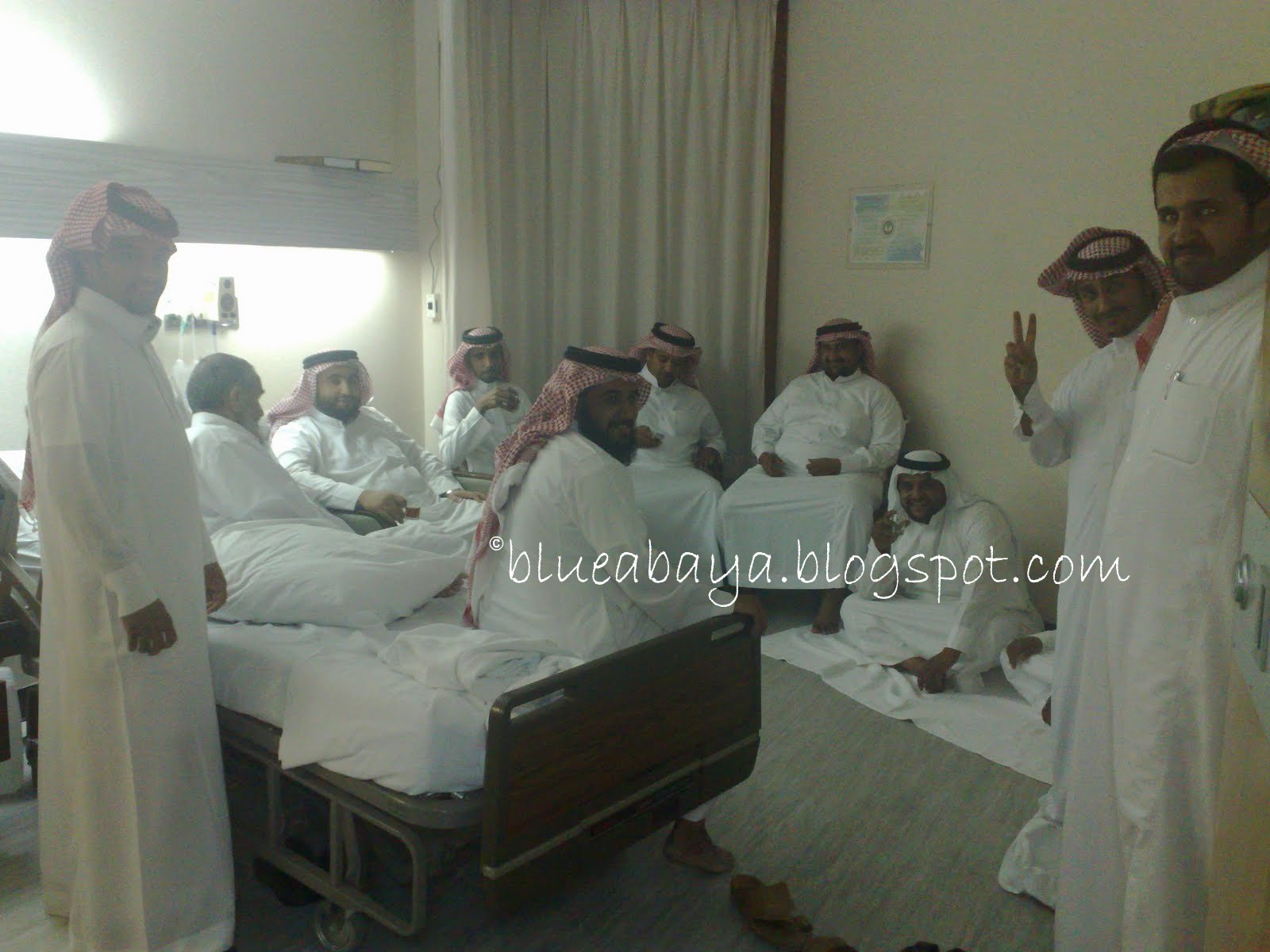
Typically the Bedouin patient will have one or two sitters present at all times. Read more about the way Saudis visit the sick in hospitals here. They will have large families and it wouldn't be strange to see ones with over 10 children. Visitors often come every evening and they will enjoy a meal or coffee and dates together.

Bedouin patients tend to have a few peculiarities compared to other Saudis. Especially the really nomadic ones have habits that they continue in the hospital, like sleeping on the floor rather than the bed! They will take the sheets off the bed and put them on the floor. Not even the pillow is needed. The sitters have a sofabed available but it's hardly used. Bedouins like to keep things simple and they don't like "modern day luxury" such as bedding.

When the patient has guests they will usually eat on the floor and with their hands. A sheet is spread on the floor and people will gather around it. Chairs and tables might be regarded as unnecessary luxuries. The youngest son or daughter will serve the food and tea or coffee out of respect to the elderly. They will most likely have their own tea or coffee pots with them in the hospital.

Guests will typically bring along dates, arabic sweets, camel milk or date filled small cakes called mammoul. The nurse will be invited to have a taste of their coffee and foods, sometimes they insist that the nurse joins them on the floor. If I have time on my hands I will sometimes join them for their dinner which they tend to eat very late. Usually long after ishaa prayers, near midnight!

I've encountered Bedouin patients that didn't know how to use the western style toilet. Some even made their business on the floor next to it. It's the first time they see a toilet seat and they don't know what to do with it.

The male Bedouins will often chew on miswak,which is a stick used to clean the teeth. Unfortunately some of them also spit on the floor after using it!

Another thing I've noticed is that Bedouins don't like to "waste" water. In other words take showers or wash their hair too often. I guess this comes from living in such harsh environments with constant lack of water. They use the water very sparingly to wash themselves, mainly it's used for performing ablutions (washing before prayer). It takes a lot of convincing or sometimes even doctors order to get them to wet themselves totally under running water!

Since they've been living all their lives in the desert, I figure their bodies have become accustomed to being warm all the time. The Bedouin patient will usually ask for the airconditioning to be turned off because they feel cold. It's actually not possible to turn it off, so then they will ask to get extra blankets even during hot summer months. The men wear thobes made out of thick wool in the winter, which for them seems to end around May when the temperature starts raising above 40. Especially in the winter months they will have layers after layers of thick clothing even though the heating is on max in the room. The women and the men like to keep their own clothing on instead of changing to hospital gowns.

When a Bedouin patient has fever he/she will be very afraid of "cooling" themselves. The more they have fever, the more the clothing and blankets will be on. Sometimes an offer of applying an icepack will result in surprises and suspicious looks. They might politely take it, but when the nurse leaves off it comes! This is sometimes a bit frustrating because the patients are convinced that warm is good cold is bad!

Bedouins love henna. Older men will sometimes color their beards with it, resulting in an orange tinged tone. Older ladies with grey hair use henna which results in the same orangy tone as the mens beards. The women will color their long naturally coal black hair with it resulting in a nice dark red tinge. Additionally they might apply decorative patterns on their hands for special occasions like Eids and weddings. The everyday henna for the hands is applied to the palms and tips of fingers so that it looks like they have very dark orange nail polish on. First time I saw this I thought to myself boy are those some dirty hands! The women will do the same with the soles of their feet and toes.

Some elderly women have tattoos on their faces sort of look like map signs. I'm not sure what they use to do them but the color is usually dark blue. It will look like small markings resembling X's or T's around her cheeks, forehead and temples. I found out this is a sign that the lady in question is of high status within her tribe. She might be the eldest woman of her tribe.

Most elderly patients will likely not know their exact age and might only be able to give you an estimate. Older generation Saudis didn't register births and they also count age according to the Hijri calendar. Also Saudi-Arabia didn't register female births until the 1970's. Estimating their age is not easy because of the harsh weather and constant exposure to sun, Bedouin often look older than their actual age. I've had very old Bedouin patients, some reaching over 100 years. They might have been healthy and never visited a hospital up to that day they come in.

Another peculiar thing which I've noticed is some of the older generation have a thin thread tied to their waists. First time I encountered one I immediately wanted to cut it off because of infection risk. They strictly refused and seemed horrified of my suggestion to remove it even though it was already harming the skin because it had become too tight. I've seen this on both men and women.
The reason for this is that they don't want to get fat so it's a weight control belt! The thread is there to remind you that you've eaten too much when the thread feels uncomfortably tight.
I wonder would this be worth patenting? The Bedouin weight loss belt!